Friday, June 29, 2012

Fairey Duckling

Hugh Coryn wrote to say that he had recently acquired a Fairey Duckling, built 1962 still varnished complete with her original suit of Williams sails.


Although still usable Hugh's intention is make whatever restoration is necessary to bring her back to as near original as possible.

In the post war years Fairey produced sailing dinghies utilising techniques that had been employed in the construction of wartime aircraft. Fairey Marine output included the Firefly, Albacore, Falcon, Swordfish, Jollyboat, Flying Fifteen, 505 and International 14's along with the much smaller Dinky and of course the Duckling which was designed by Uffa Fox.


The hot moulding process was an adaptation to post war boat building of the method originally developed by de Havillands in the 1930's for �stressed skin� wooden aircraft production, using layers of agba sandwiched together with glue over a male mould and �cooked� in a large oven called an �autoclave� By using true mass-production techniques, Fairey Marine were able to turn out vast numbers of identical boats at an unprecedented quality and price.

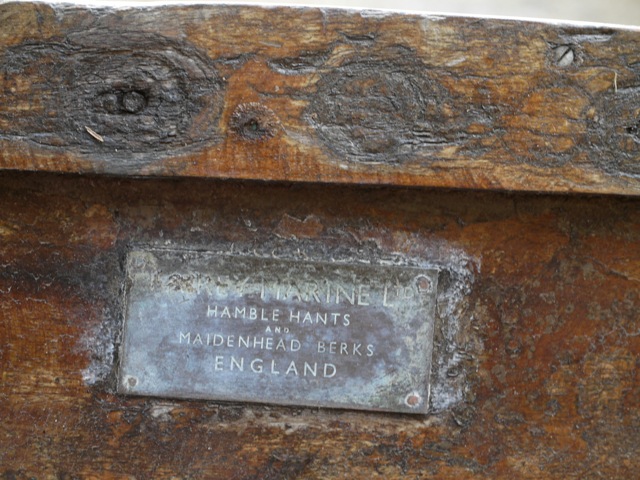
As you can see Hugh's boat is a Hamble native.


for more information, click this image

Saturday, June 9, 2012

Fairey Atalanta

Decked out for the Royal Jubilee this Fairy Atalanta has it's origin if not precisely in the Coronation year 1953 but is certainly a product of that post war period of English enthusiasm and innovation.

Fairey Marine applied hot moulded wooden construction developed in wartime, to production boat building, the technique enabled light weight and strong construction in the days before GRP became ubiquitous.

History recalls the Atalanta came about through the collaboration between Allen Vines a senior Fariey Marine executive and designer Uffa Fox, the Atalanta was conceived as a trailable shallow draft performance cruiser with the sea keeping capabilities and safety of a fin keel yacht.


There were three variants of the Atalanta, a 26ft (8.1m) hull with a slightly shorter cockpit and more headroom called the Titania (named after another Fairey flying boat), a larger version the Atalanta 31 (9.45m) and the Fulmar a 20ft(6.1m) version with a single lifting keel.


In 1955, Fox designed a 24ft (7.32m) prototype based on some of the concepts demonstrated by Vines in a development of the company's Albacore and after extensive trials the first 26ft (7.92m) Atalanta class boats were launched in June 1956. By 1968, when production ceased, some 291 Atalanta variants had been built at Fairey�s Hamble Point yard.

The Atlanta has a double berth cabin aft and a two-berth cabin, galley and heads forward. The self-draining cockpit has room for six, the unconventional but practical whipstaff tiller allows the maximum space to be utilised. Control lines, and halyards are handled from the cockpit and the headsails and anchor can be deployed by standing in the forehatch. The relatively modest rig and sail area needed to drive the lightweight hull make for easy sail handling as well as lower capital cost, with the additional benefit that the short mast is easily rigged or lowered for towing.


Many of these craft are still sailing and there is an active owners association plus you can follow Atalanta owner and fellow blogger Roy Woolley for first hand insight. for more information, click this image

Saturday, March 31, 2012

Brigand

We had an interesting letter from Francesco Tomei who describes himself as " proud italian owner of the wonderful Brigand 7,50 - Nonnopio."


The Brigand was built in Italy by C.I.M.A. shipyard during the 1970's to a design by Charles Nicholson of Camper & Nicholson. Other than several examples for sale Google failed to come up with any more information on the Brigand, it's an interesting connection as I believe that C&N also sold the 303 under license in Italy which was a Ron Holland designed IOR half tonner made infamous by the 1979 Fastnet disaster.


Francesco completely restored Nonnopio in 2006 at his yard in Viareggio, he writes "this amazing little jewel deserve to be on the list of your 1001 boats, and on a good ranking position too! In my opinion, looking at the designer, at the shape and at the marine qualities she could be on the same level of boats like Muscadet and Ecume de Mer."


He continues, "
these last 2 models are probably much more famous because in France, as well as in Great Britain there is a much deeper and bigger sailing tradition than in Italy.

Brigand really deservse your attention, because she still holds the market very well, as much as the sea itself, in the harbour of my city (Viareggio) there are at least 10 of theese boats, and much more in Italy, and in regatas she often wins against younger and bigger boats.... also in real time."

"with friends or by myself, with any kind of weather She always took me home... ok, I've never faced an hurricane, but I've sailed from Calvi to Capraia Island in 7 hours and 30 minutes with a Mistral at 53 knots, and I've faced the Sea more than one time."


Having sailed the Mediterranean and experienced the sudden force of the Tramontana, a wind similar to the Mistral in the south western parts of France and Spain I know that Francesco's description speaks of a good sea boat.


Thanks to Francesco for bringing Brigand to our attention and providing insight about the boat. A Google search doesn't provide much information so if any readers know more about Brigand wed be delighted to hear from you. for more information, click this image

Friday, February 3, 2012

Swan 38 - The Definitive Cruiser/Racer

Readers of novels are willing to believe the most outrageous and tortuous plots - in the case of my, as yet, unfinished novel it's about unethical journalism, civil service corruption and murderous politicians - but only if the small, familiar details are correct. Since the central character in the tale I am currently writing, has to sail through, and survive, a terrifyingly violent storm, and later prevail in a fight with one of the chief villains, while navigating the overfalls of a treacherous tiderace, in a wind-over-tide gale, (guess who goes overboard!) my choice of boat was an easy one. Just as James Bond would not be credible without his Walther pistol and his Aston Martin, my story's hero, so my theory goes, could not be sent into stormy waters in an inadequate boat. If the detail is wrong, the plot will sink without trace.

The above, I hope, helps explain two things; why I have been too occupied to write here for a couple of months, and why I'm now writing about a Finnish boat instead of a French one.

The Swan 38 is one of my two or three favourite ever boats, and the only one I could choose for my fictional hero. If I wanted a boat I could trust to last me for the rest of my life, and to take me anywhere I desired to sail, the Sparkman and Stephens designed Swan 38 would be number one on my list. In terms of quality of build, design pedigree, strength, longevity and looks, this boat can stand comparison with any other yacht produced anywhere, at any time. But what makes the Swan 38 better, to my mind, than any other yacht of its size, is its ability to make open sea passages in all weathers, while keeping its crew comfortable, confident, and rested.

The design was commissioned from the legendary New York architects Sparkman and Stephens by the Finnish yachtbuilders Oy Nautor Ab in 1974. Nautor had already had considerable commercial success with a series of S&S designed Swans ranging from 36 to 65 ft LOA. The Swan 38 was designed as a more compact version of their outstandingly successful 1967 Swan 43 design, which had proved to be a fast boat at every level of racing competition, even winning a place in the 3 boat British Admiral's Cup team of 1969.

At the time of its introduction, Nautor had recently undergone a change of management, but the new owners were as determined as the founder, Pekka Koskenkyl�, to build yachts of the highest quality. The 38 is no exception. It's backbone is a massive stainless steel girder, solidly glassed into the bottom of the hull. This rigid base carries the loads of the mast and of the 7000lb keel and endows the GRP hull with enormous strength and stiffness. Most of the boats were built with a teak deck beautifully laid on top of the GRP top moulding. This deck, though lovely to look at, will inevitably need replacing one day at considerable cost, and for the keen racer, its weight must be considered unnecessary. But, if you're thinking of becoming the owner of a Swan, you will probably be prepared to put up with the extra expense, every quarter-century or so, in order to be able to walk those teak planks.

No doubt experts will correct me if I'm wrong, but I believe the 38 was the first of the Swans to sport the signature, low, slope-sided, coachroof wedge which seems to grow out of the deck and merge into the cockpit coaming, and which, for a time, became a characteristic feature of the marque, until it was copied by many other designers. This feature makes the decks appear wider and allows excellent forward visibility from the cockpit.

Down below the joinery is immaculately made and polished to a cabinetmaker's finish. The Swan 38 was considered a roomy yacht in its day, and although it can't now compare for spaciousness with modern yachts of similar overall length, the hull's deep sections and relatively substantial displacement give it plenty of volume, so storage space is generous and useful.

Unlike the larger 43 of the same era, the main saloon is abaft the through-deck mast, so the social space is unobstructed. There are good seagoing pilot berths outboard of the settee berths so that the off-watch crew can sleep securely in bad weather.

The forward facing chart table to port allows the navigator to work on a large flat area, with bulkhead space for instruments, under-desk storage for charts, and, on some boats, a useful shelf for pilot books, without disturbing any resting crew. It is separated from the decent size galley opposite by the engine box and companionway steps. Behind the navigator there is a good size oilskin locker.

Further aft there is a usefully private, if slightly cramped, aft cabin under the cockpit. It is reached by a short passage on the port side, and it offers a double berth for when you get lucky in harbour, as well as a single quarter berth to port. There's not much headroom here, but the space gives the owner or skipper some privacy, and allows him, or her, while lying in the starboard double berth, to communicate with the crew through an opening hatch to the saloon, or through a small opening port into the cockpit.

Forward of the mast there is an adequately roomy WC/shower compartment to port with hanging locker and drawer space to starboard. Further forward still, the forecabin is dominated by bin stowage for the wardrobe of racing sails that a yacht of this type would have been expected to carry. Pipecots fold down over the bins when needed for harbour use. Many of the boats have now been adapted, for cruising or charter, by having this space converted into a proper cabin for two with a permanent 'V' berth.

The cockpit is comfortable but not overlarge, as in inshore racing situations most of the crew would be on deck, either perched on the weather rail or operating halyards, downhauls and winches grouped on a flat working area of the cabin roof abaft the mast. When racing or cruising offshore, only half the crew could be expected to be in the cockpit at once; the rest would be below for much of the time. There is a liferaft stowage locker to port, and a bridge deck which, together with a single shallow hatch slide, prevents water from a flooded cockpit entering the cabin.

The Swan 38 is an easy boat to sail. Her wide decks enable rapid and safe crew movement for sailhandling and harbour manoeuvres, and the simple, single-spreader rig enables her to be sailed shorthanded. Being a pedigree S&S design, she handles beautifully on all points of sailing, especially to windward, when she can be trimmed to balance perfectly with just enough weather helm for feel. Like most IOR inspired yachts of her day she can sometimes be a handful when sailing fully-powered dead downwind.

Production of the Swan 38 ended in 1979 with 116 hulls built. Today most examples will have been fitted with headsail roller reefing gear and modern electronic navigation aids. The best examples will have been professionally maintained by a top quality yard and may have new teak decks and an upgraded modern diesel. If you want one you will probably have to spend �70-100,000, but this could turn out to be an excellent investment, as prices are unlikely ever to fall below today's.

The Swan 38, in my opinion, is the best cruiser/racer ever. She may not be as fast downwind in smooth water as a some other boats of her size. She may not be as roomy as most more modern 38 footers. She won't plane on a reach at 15 knots in a 12 knot breeze like some of today's ultra-lightweight scaled-up dinghies. She is, however, one of a very few great sailing boats that can win races, cross oceans, go weekend family cruising or shorthanded passage making and can be absolutely relied on to make ground to windward in gale force wind and heavy seas when your life depends on it. As a bonus, she is strongly built and finished to immaculate standards by Nautor of Finland, a marque which, for yachtsmen of my age, carries the same exclusive cachet and promise of quality, as the Rolls-Royce brand once did for motorists.


Swan 38


Designer: Sparkman & Stephens
Builder: Oy Nautor Ab (now called Nautor's Swan)

LOA 38'-0"
LWL 28'-9"
Beam 11'-7"
Draft 6'-4"
Displacement 16,120 lbs
Ballast 7,050 lbs
Sail Area 682 sq ft

Acknowledgements:

Thanks to James Bull of Swan Yacht Charter for permission to use the images shown here. More photos and details of the Swan 38 "Cimaroon", available for charter, can be found at the Swan Yacht Charter website

Further links:
Article at Boats.com
Sparkman & Stephens (to view drawings and plans)

for more information, click this image

Friday, December 23, 2011

Slacktide

Here�s something very different from Dave Zeiger of TriloBoats which are a family of barge/scow hulls that have been adapted for fast and easy construction in plywood. Dave and his family have what might appear an alternative and enviable lifestyle living aboard their 26 foot Trilo - Slacktide among the islands of Southeast Alaska's Alexander Archipelago.


If you think of Dave and family in terms of Ralph Waldo Emerson then perhaps Slacktide is analogous to Walden Pond. At 26' x 7' x 1' Slacktide is engine-free, a junk ketch-rigged sailing barge �not one of those curvaceous barge-babes, either, but a four-square and unrepentant box barge�


Slacktide is wind and human powered so sailing, sculling, drifting and idling are important pastimes. When the wind is fair and the tide a'rising, she will skim the shorelines or thread tiny passages between islets. When at anchor or waiting on the next tide Dave and family are afforded the perfect location from which to while away the day, drawing (boats from Dave, plants and animals from Anke), making music and exploring realms of the senses.

Compared to many of the boats featured on 1001 Boats �Slacktide� might be described as plain or even odd, but that�s to miss the point and a long history of slab sided working boats such as the sharpie, scow and barge. Reference England�s east coast barge trade, square section barges of 80 to 90 feet carrying immense cargos of up to 100 tons under sail through the shoal rivers and right into the port of London, often crewed by just a skipper and mate speak of an efficiency and fitness for purpose. In her way Slacktide draws many parallels, her form is a direct consequence of her intended function and owners purpose.


That�s not to say that Dave�s aesthetic is constrained by straight lines functionality, as he comments on his blog,

�.. don't get me wrong! I love curvaceous beauties, gleaming golden in every lissom line! The glint of brass and stalwart patina of bronze. Makes my heart go pit-a-pat!�

If I had a magic wand� sweet and curvy would suit me just fine. She'd be cold-moulded and dynel sheathed. Copper plated, from the boot-stripe down in strips hand-spilled and hammer fit by masters. She'd be tricked out with bronze hardware and copper running lights. Teak decks and resin plus gel-coat in lieu of paint. For easy maintenance, you know. A custom, welded stove would warm her, reminiscent of the old Shipmates, right down to the embossed anchors on the face.�

But I think of our box barges as the Least Common Denominator in boats. They are, quite literally, the least possible effort you can expend and still have a capable cruiser. KISS, even by barge standards. By almost any performance criterion, it's uphill from there. They are the lowest of the low. The bottom of the barrel.

But that's kind of empowering, don't you think? Look at how well they do... look at all the fun you can have on one! Their virtue is that their bang-for-the-buck ratio is through the roof. If any dreamboat is in reach, it's this kind, and it just gets better. And they do have sort of work-a-day good looks to them... don't they? Anyone?�


The answer to which is �yes they do.�


For further proof point of Slacktide�s fitness for purpose we should perhaps look at Dave�s previous boats. The first was a 19 foot Phil Bolger built Micro called Zoon, despite her small size the family proved to themselves that such a sailboat, even a small one �might be a good place to live.�

Zoon was followed by Luna, described as 31foot and �Bolgeresque� a slightly larger interpretation of Phil Boger�s Advanced Sharpie AS29.


With Luna sold and lessons learned, Dave and family used their unique experience when they embarked on the design and build of Slacktide, as the next generation vessel which incorporates several features ranging from unusual to outright experimental.


Sea trials were aimed to answer questions about the viability of the following:

Slacktide is a box barge � while there are several examples of sailing box barges, few if any sail as general cruisers in anywhere near the range of conditions found in SE Alaska, in particular, could she make good in moderate gale conditions?

The bottom is a trampoline structure, there are no internal stiffeners over the large and dead flat cabin sole (the inside of the hull). It's designed to flex. As a result the copper bottom plates were glued, not fastened to avoid barnacle-like nail-heads

The large, side-windows are little more than a foot above the waterline.

The low foredeck is just over two feet above the waterline in order to maximize the forward windows and allow good steering visibility from a sitting position, inside the cabin.

Her centre boards are arranged on cable travellers to allow them to stow aft providing a clear and unrestricted view while at anchor.

The mizzen mast is off-center � displaced over one foot to port.

The junk topsail cut is unusual � inspired by Polynesian crab-claw rig.

A SeaCycle � Drive Unit has been fitted for windless propulsion � this is like an outboard, but with rotary pedals (like a bicyle's) in place of the motor


SLACKTIDE was intended for year-round, live-aboard cruising, since Dave and family have been living continuously aboard now, through two and a half seasons sailing about 428 nautical miles, they have had good opportunity to test her suitability. Details of those extended sea trials are available on their web site, in the sense that Slacktide is a boat that gets you where you want to be, the photos suggest that she does the job well


Luna

Slacktide

Blog for more information, click this image

Saturday, December 17, 2011

Foxer Dinghy

Members of the Hamble River Sailing Club Foxer Fleet can be seen sailing every weekend, out on the water all year around summer and winter alike.


Designed by David Thomas (who also designed the Sigma 33) as a versatile sailing dinghy and yacht tender, the Foxer attracts some very experience helms and the fleet is characterised by close and competitive racing.

Length: 3.25m (10' 8")
Sail Area (Mono): 6.3m� (68 sq ft)
Beam: 1.37m (4' 6")
Weight: 78 kg (172 lbs)


The FOXER is a boat you sail IN rather than on. The exceptional stability and simple to control rig means there is no need to perch on the sides or hang overboard when sailing to windward - helms aged 8 to 80 with any degree of physical fitness can sail within their limits, while enjoying outstanding sailing qualities and safety.

The distinctive red, black and white Foxer sails have become and integral part of the Hamble weekend waterfront. for more information, click this image

Wednesday, December 14, 2011

Nicholson 48

I�m not really a fan of centre cockpit yachts, but the exception proves the rule as they say. The first time we went aboard a Nicholson 48 was in Scotland Bay, Trinidad. Growler monkeys could be heard among the steep and thickly wooded shore as we rowed over to swap some books, our conversation led to an early evening beer and on to a dram from the ships supply of single malt.


Our hosts proudly showed us around their boat and what we discovered was a strongly built and hugely practical long distance cruiser. Designed in the 1970�s for serious offshore cruising the Nicholson has a full, encapsulated keel, comfortable motion and well planned accommodation. With a sail area to displacement of 12.07 the Nic is perhaps a little under canvassed but the ketch rig, with everything in board, is easy to work with a small crew. The deep centre cockpit with permanent cover works equally well offering protection and security from the in the blazing Caribbean heat or the cold, wet waters of the Western Isles.


Although the styling places the Nicholson firmly in the 1970s � touches such as the venetian blinds seen on many examples, the design has a timeless quality and an image which speaks of quality and fitness for purpose which has aged well.

LOA 47' 6"
LWL 34' 3"
Beam 12'
Draft 7' or 5'5" (shoal draft version)
Displacement 31,300lbs
SA/Dis 12.07
Bal/Dis .32 for more information, click this image